In this latest webinar, join Energy Management Corporation and Generac (2nd largest generator manufacturer in North America) and learn about paralleling generators.
Generator Paralleling: Navigating Modern Solutions for Enhanced Energy Management
Key Takeaways:
• Exploring generator paralleling and its significance for redundancy and capacity enhancement.
• Delving into the detailed synchronization processes and their implications for reliable power supply.
• Evaluating real-world applications and cost considerations for paralleling solutions.
As global energy demands surge, organizations are increasingly looking for advanced strategies to ensure reliable, scalable, and cost-effective energy management solutions. One of the cutting-edge methodologies gaining popularity is generator paralleling. This process involves the synchronization and joining of multiple generators to create a unified power source. While it sounds straightforward, generator paralleling is intricate, requiring precise coordination to achieve effective and safe results. In our insightful webinar, hosted by Energy Management and led by John Sharp of Generac Industrial Energy, we explored the depths of generator paralleling—from the basic concepts to high-level applications and future possibilities.
Understanding Generator Paralleling: Redundancy and Capacity Enhancement
Generator paralleling serves two primary purposes: increasing generation capacity and enhancing system redundancy. John Sharp, during the webinar, underscored this dual function, stating, “Why would you parallel? You’re either trying to increase your generation capacity or you’re looking at doing some sort of redundancy.” By connecting multiple generators, facilities can achieve a backup system that remains functional even if one unit fails, thereby ensuring a continuous power supply.
This redundancy is critical for businesses where power interruptions can lead to significant operational disruptions. Sharp elaborated on this, explaining, “Single generator reliability drops if not maintained, so having redundancy through paralleling ensures higher reliability, as parts of the system can compensate for any failure.”
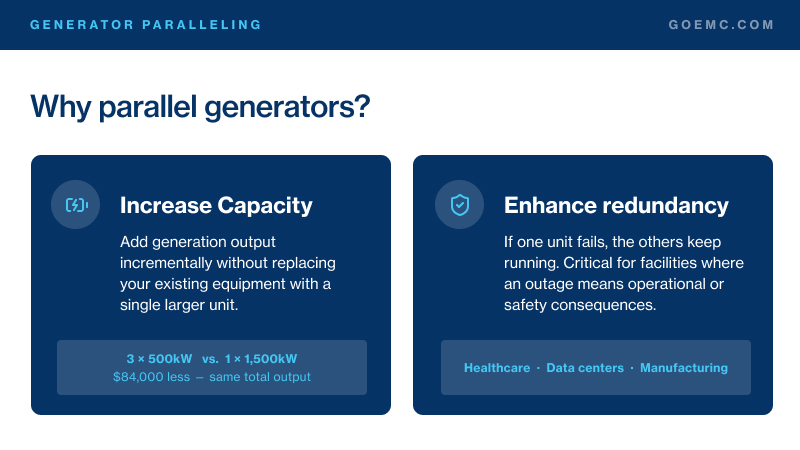
Moreover, with scaling businesses in mind, paralleling offers an economical path to capacity enhancement. Instead of investing in a costly upgrade to a larger generator, businesses can incrementally scale their power output by adding more units, thus optimizing their capital expenditure.
The Technical Nuances of Synchronization
Synchronization forms the crux of generator paralleling, involving meticulous alignment of voltage and speed across units. Sharp detailed the synchronous process, sharing that “The generators have to be running at the same voltage and same speed to be locked together electrically.” The goal is to achieve seamless transition and cohesion among units without causing overloading or phase mismatches.
He further explained the synchronization method, “We’re going to control generator two to make it match and mate up to generator one.” This involves adjusting both the excitation and speed of the generators to match sine waves, securing an efficient and stable power output. It’s a sophisticated dance of technology requiring precision and real-time adjustments—a process significantly enhanced by today’s digital innovations.
Addressing the synchronization technology, Sharp detailed the utility of modern controllers, saying they “allow you to bias the voltage regulator and the governor, maintaining proportional load distribution.” Such advancements underscore the shift from labor-intensive manual synchronization to intelligent, automated systems capable of handling complex computations for real-time adjustments.
Real-World Applications and Cost Implications of Paralleling Systems
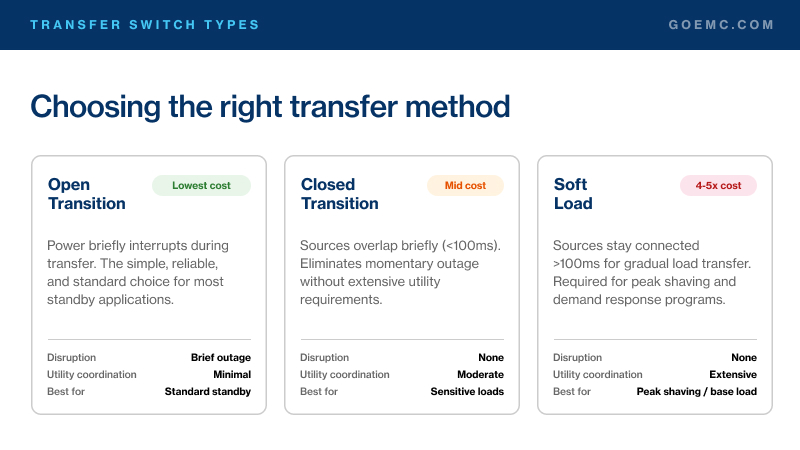
Adapting generator paralleling in practical applications can vary widely, depending on needs and existing infrastructure. One notable application is within facilities looking to adopt economic dispatch strategies, such as peak shaving or base loading. Sharp noted the financial considerations in these scenarios, explaining, “This soft load transition switch is probably four to five times the cost of a closed transition switch…but the economics, the dollars, and cents really need to be worked out.”
For larger installations, the choice often comes down to integrating either traditional paralleling switchgear or modern integrated controls. Sharp acknowledged that switchgear can be “expensive, large, and complex,” paving the way for integrated systems that are compact and cost-effective, thus broadening access to redundancy solutions.
In Sharp’s assessment of integrated paralleling systems, he emphasized their adoption in mid-scale facilities such as grocery stores and data centers, which cannot bear the footprint or financial burden of traditional switchgear. These systems offer an effective path for businesses to implement robust energy management strategies even in confined spaces, such as rooftops.
Facilitating the decision-making process, businesses need to weigh upfront capital against long-term operational benefits. Whether employing multiple smaller generators or fewer larger ones, the choice impacts maintenance schedules, fuel efficiency, and ultimately, cost-effectiveness. Sharp illustrated this with a concrete example, “Three by 500 was $84,000 less expensive than one 1500,” illustrating the cost advantages of smaller, scalable units.
Generator paralleling represents a progressive step in effective energy management, offering businesses reliability, redundancy, and scalability. By integrating advanced synchronization technology, facilities can ensure a seamless blend of multiple power sources, leveraging the inherent strengths of each to maintain a steadfast energy framework. As intricacies continue to evolve, understanding the underlying principles and tailoring solutions to specific needs will open pathways to innovative energy resilience, paving the way for future development and sustainable growth.